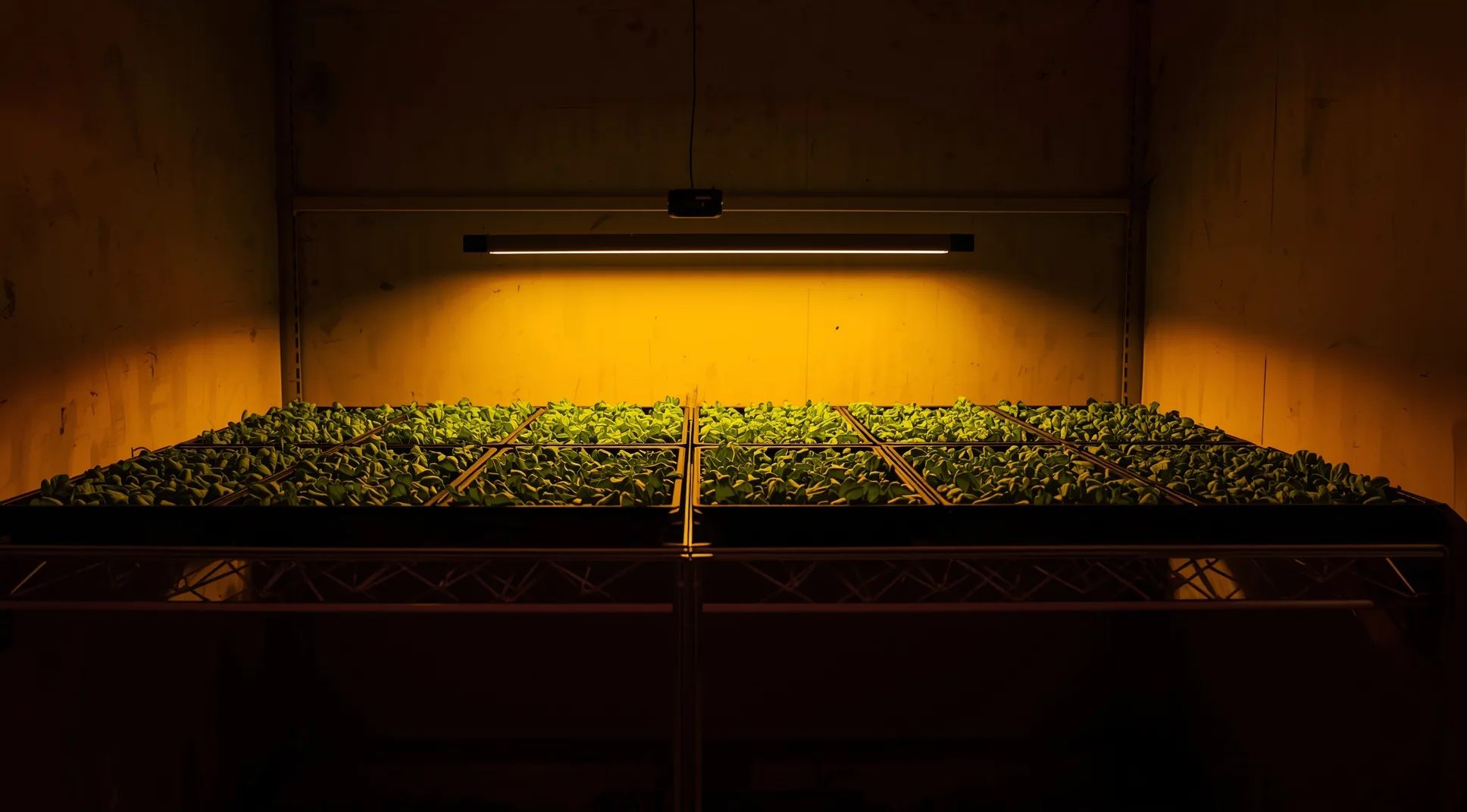
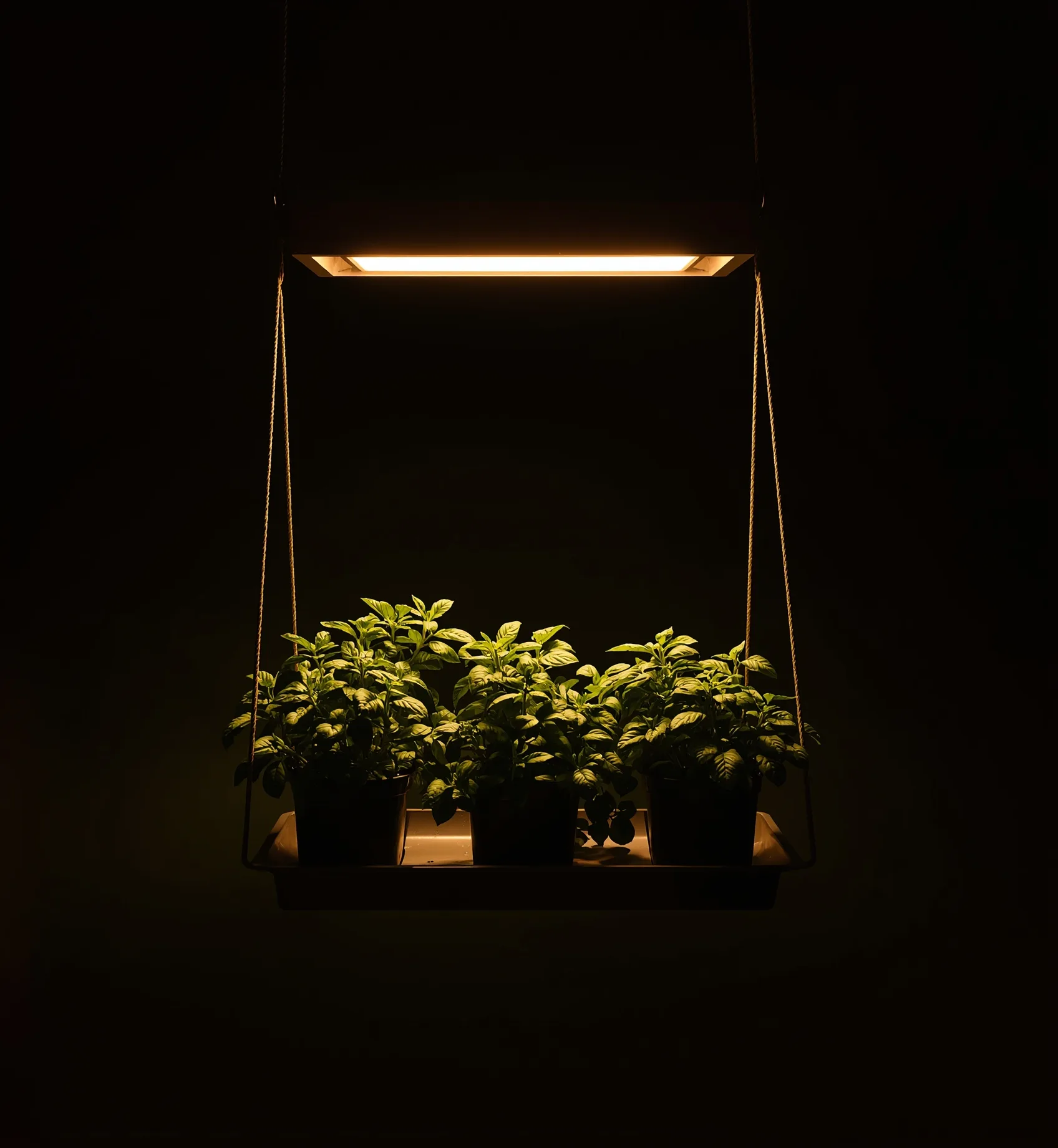
Wrong height: too close bleaches and curls leaves; hung at the ceiling it delivers decoration PPFD. Follow the stated height, then change one variable a week.
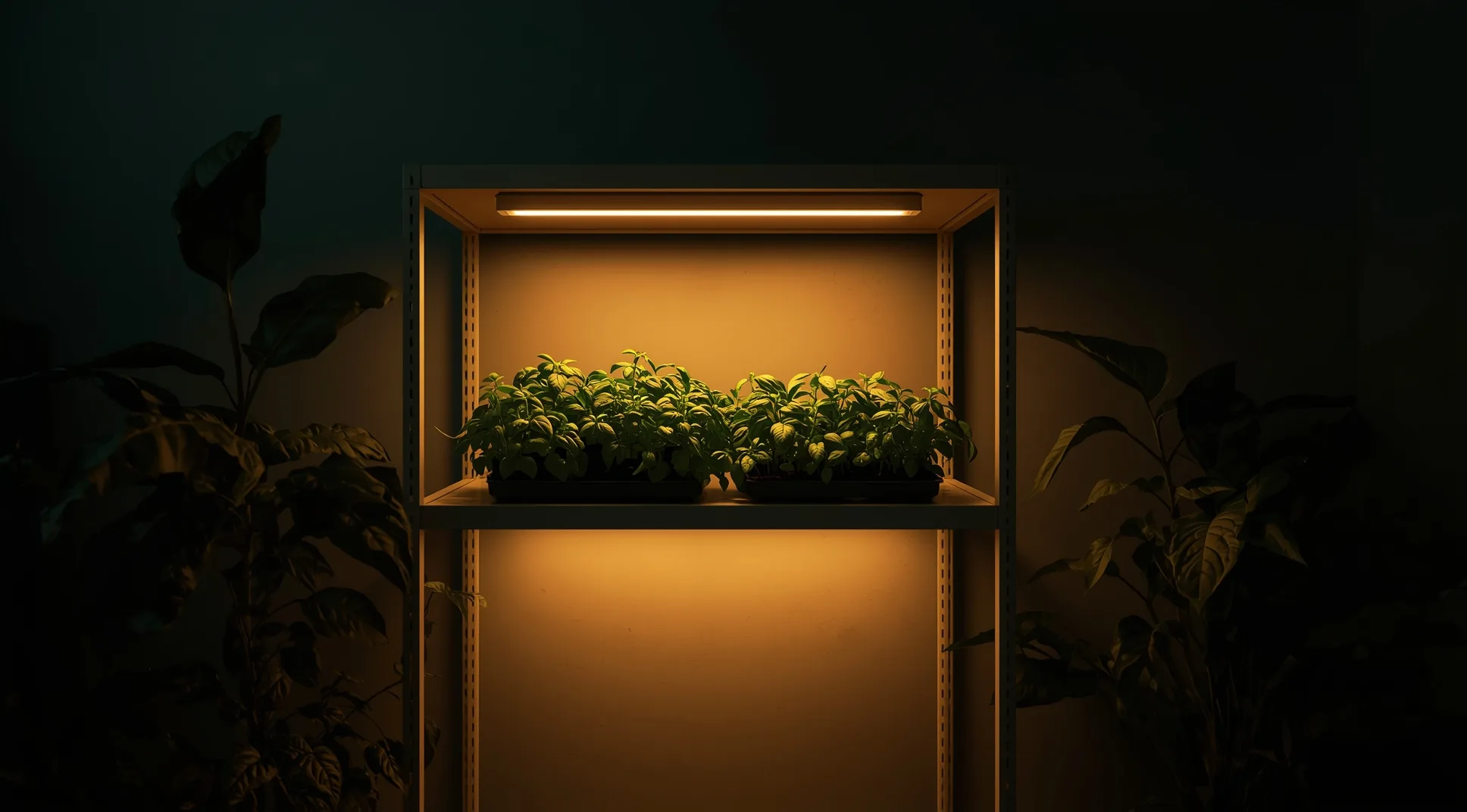
Most LED grow lights are sold by watts — the number the fixture drinks, not the light your plants get. We spec ours by PPFD: measured photons, mapped corner to corner at a stated height.
Get the light map
PPFD — photosynthetic photon flux density — counts the usable photons landing on a square meter of canopy each second (µmol/m²/s). It's the plant's-eye view of a light. Two fixtures at identical wattage can deliver wildly different PPFD, depending on diode efficiency and optics.
The working ranges are friendlier than the units sound: low-light houseplants cruise at 50–150 µmol, leafy greens want 200–400, fruiting plants need 400–600, seedlings start at 100–200. The trap is the single-point spec — PPFD quoted dead-center at an unstated height. A fixture can hit 800 mid-panel, 90 at the corners.
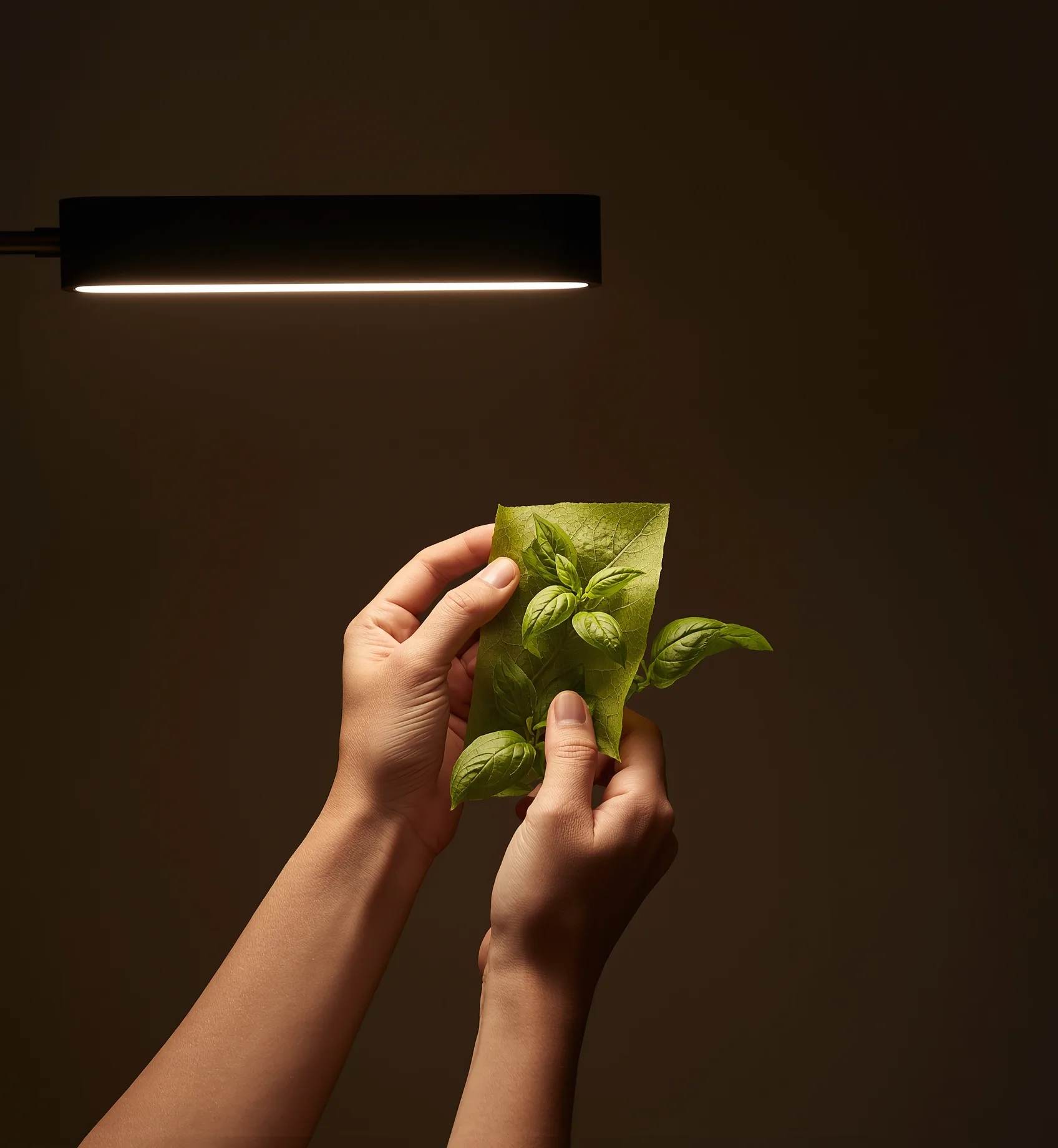
The blurple glow came from a real insight taken too far: chlorophyll peaks in red and blue, so early LEDs shipped only those diodes. Plants grew, but you couldn't spot leaf problems under the magenta, and plants use far more of the spectrum than the peaks suggest.
Full-spectrum white LED grow lights won for sturdy reasons: green light drives photosynthesis deeper in the canopy, a broad spectrum renders leaves in true color so you catch problems early, and white is livable. Warm white (3000–3500 K) with a red bump suits fruiting. Ignore magic-ratio marketing.
A fixture's usable footprint is smaller than the ad photo. Light falls off fast, so a low panel burns the center and starves edges. Judge coverage by uniformity: a min-to-average PPFD of 0.70 or better, corners included.
We list LED grow lights as 'X × Y cm at Z cm height, minimum corner PPFD N' — four numbers, no adjectives. Match that coverage area to your shelf, add 10%. If a listing won't state corner PPFD, that's your answer.
Wrong height: too close bleaches and curls leaves; hung at the ceiling it delivers decoration PPFD. Follow the stated height, then change one variable a week.
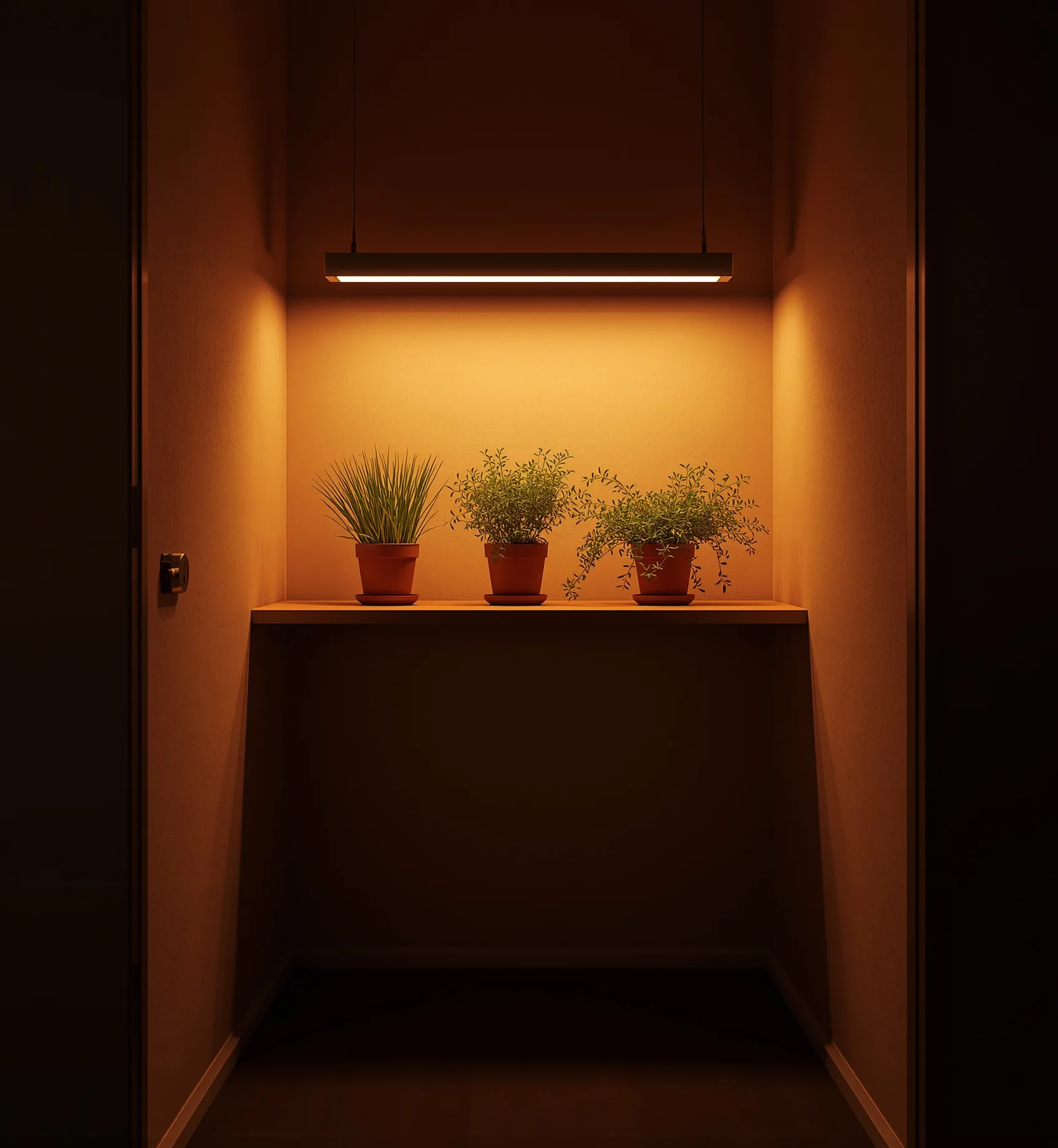
Corners and timers ignored: edges etiolate while the center thrives, and photoperiod by memory is chaos. Size coverage right, or rotate pots, and use a timer.
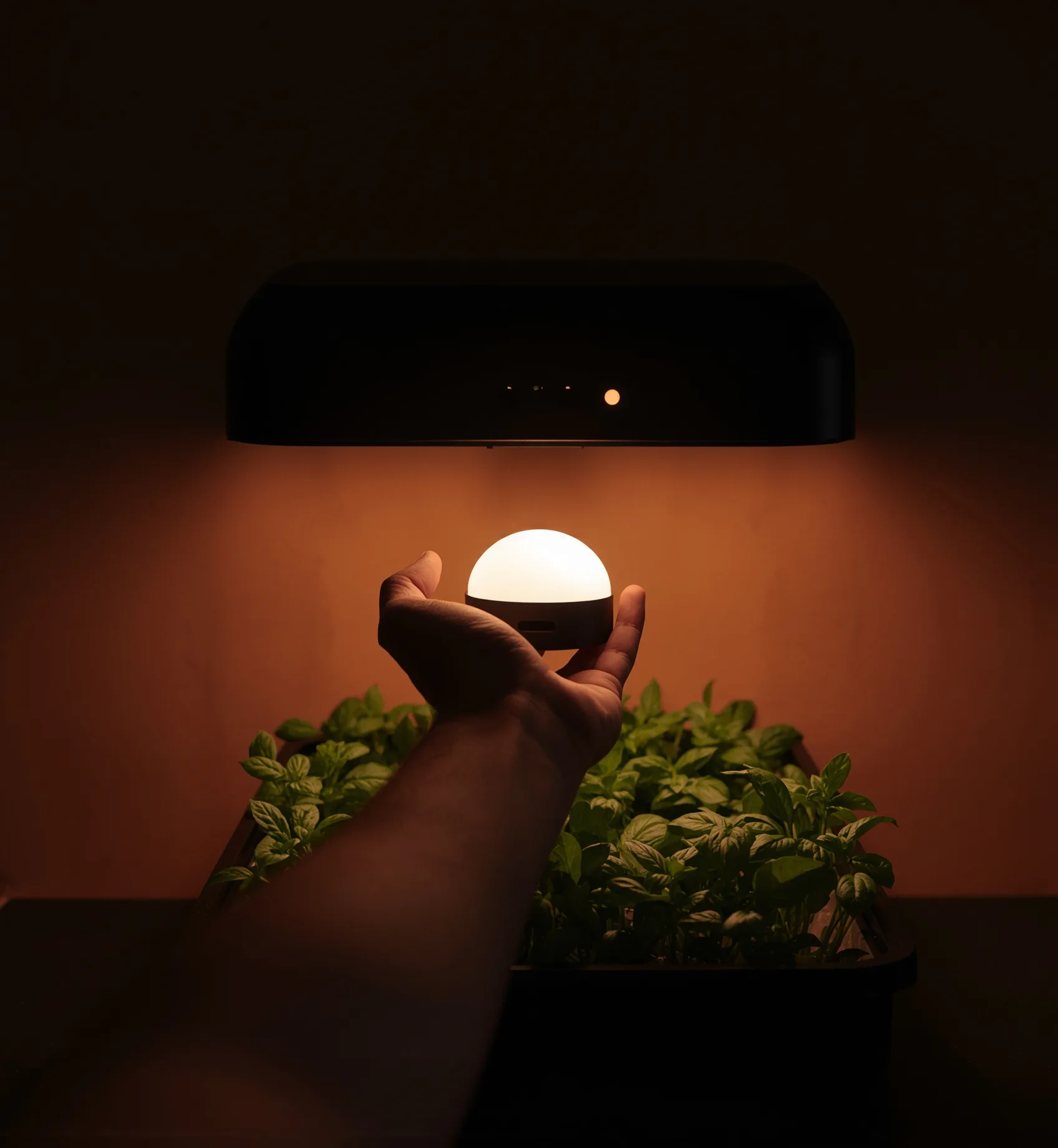
Measuring nothing: a lux meter and a white-LED conversion — divide lux by ~70 — beats guessing. Growers who measure once outperform those who upgrade twice.
01
2.8 µmol/J, published
02
60×60 cm even at 40 cm
03
3500 K white + red
The number that matters is photon efficacy — micromoles per joule (µmol/J). Quality boards run 2.5–3.0; bargain fixtures sit below 2.0, so a third of your bill buys heat instead of growth. Efficacy compares fixtures across sizes the way fuel economy compares cars.
Heat is the same story reversed: every joule that isn't photons stays as warmth. Efficient boards run passive-cooled and silent; inefficient ones need fans, and fans hum in the bedroom where the herbs live. Quiet is an efficiency spec you can hear.
01 — Growlightia
Plants add up light over the day — the daily light integral, or DLI — so hours and intensity trade off. Greens under moderate PPFD for 16 hours can match stronger light run shorter. A modest fixture on a longer timer often beats a monster your shelf can't fit.
The limit is biological: most plants want six-plus hours of real dark, and tomatoes sulk under 24-hour light. The rig is unglamorous — a timer, 14–16 hours for greens, 12–14 for fruiting, dark the rest. Set it once and leave it.
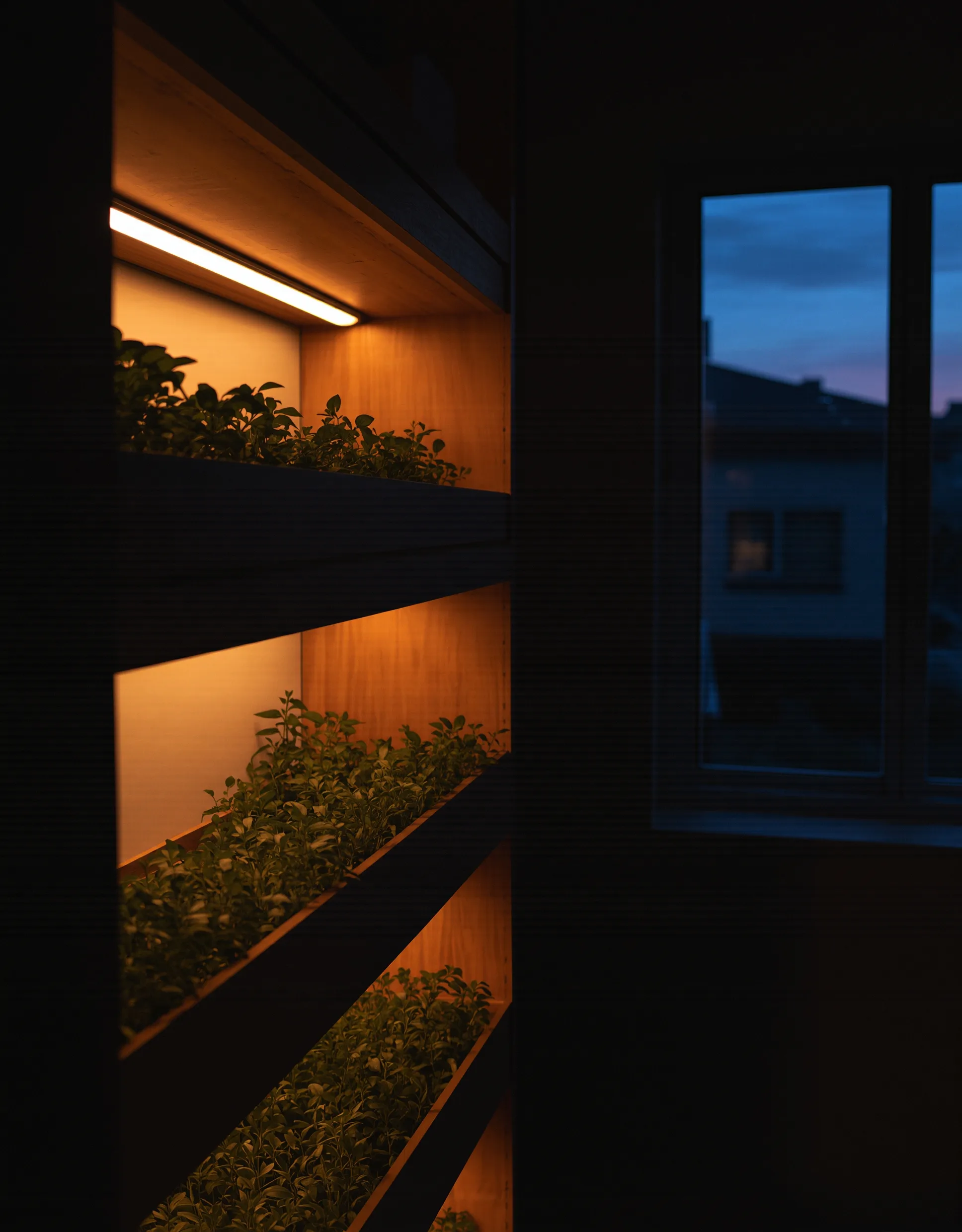
02 — Growlightia
The most common first grow light isn't for a tent — it's for houseplants starving through a northern winter, when a south window drops to a fraction of its June light. The plants don't die; they stall, drop leaves, and wait.
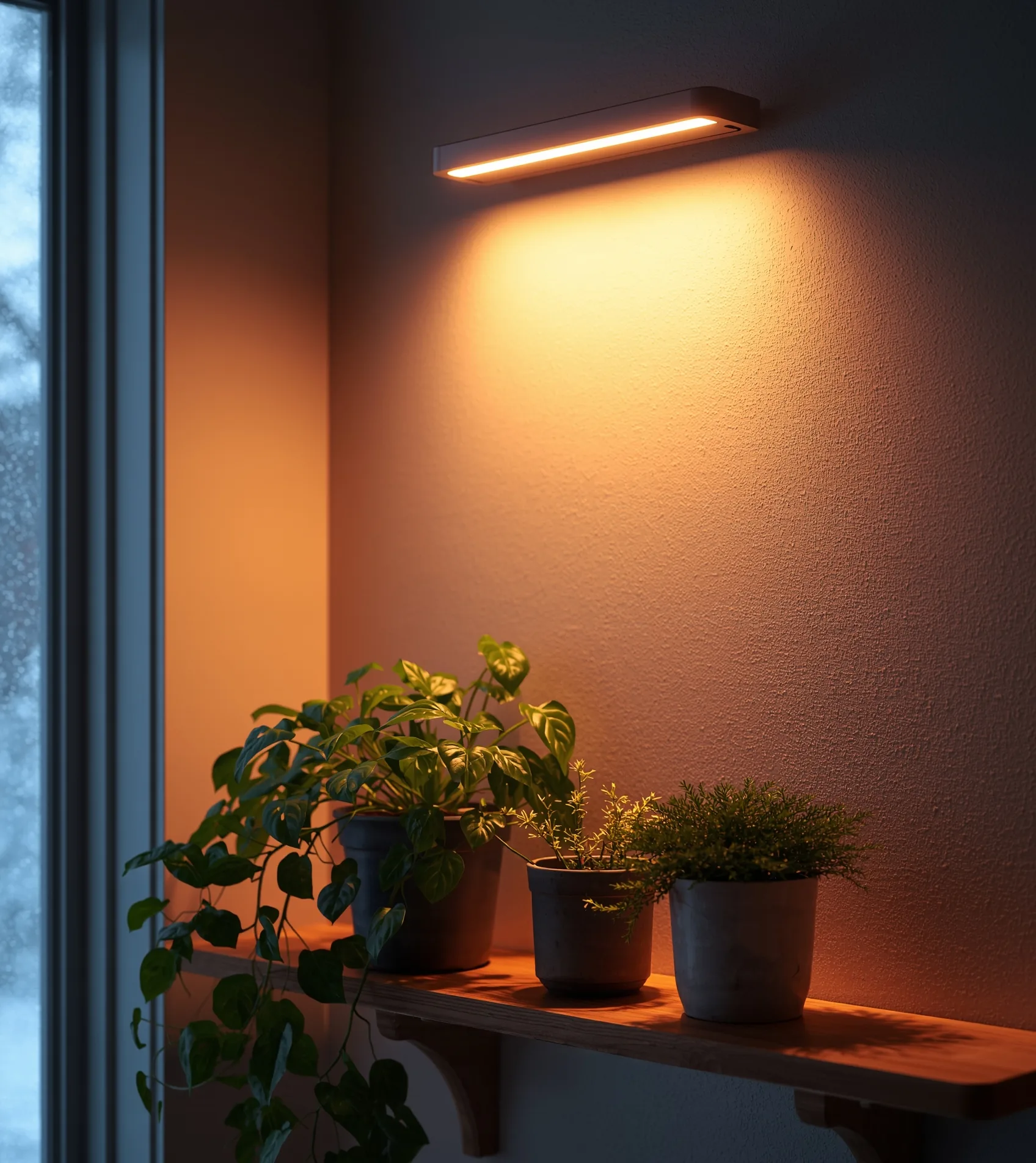
Supplementing beats replacing: a modest bar run 6–10 hours as a top-up usually rescues them, lit from above so plants don't lean. A shelf pair like the GL-Shelf Duo over a cluster does this quietly. Come spring, dial the hours back.
A 100-watt passive-cooled full-spectrum board at 2.8 µmol/J: edge-weighted diode layout for honest corner coverage, dimmable driver, dead silent. Covers 60 × 60 cm at 40 cm height with corner PPFD above 250 — and rated to hold output for years, not seasons.
$149 USD
Spec the GL-100Reframe it: how much PPFD does your canopy area need? Greens want 200–400 µmol across the tray, fruiting plants 400–600. Then find LED grow lights whose published coverage map delivers that at your shelf's real dimensions. Watts is what you pay; PPFD is what you get.
The GL-Shelf Duo on a 16-hour timer over a 90 cm shelf covers basil, parsley, and mint properly for under a hundred dollars all-in. The mistake to avoid is the decorative clip-on bulb that delivers 40 PPFD and a slow, leggy disappointment.
A 100-watt efficient board adds about as much heat as a bright old incandescent bulb — noticeable in a sealed tent, negligible in a room. Running cost is one line: watts × hours ÷ 1000 × your rate, so a 100 W board on 16 hours is 1.6 kWh a day, pocket change. Ours are passive-cooled, so no fan noise either; the herbs can live in the bedroom.
Start at the height our coverage map states for your target PPFD — for the GL-100, 40 cm for greens. Then read the plants for a week: pale, stretching growth means closer or brighter; bleached or curling tips mean back off. Change one variable at a time.
They photosynthesize, but full-spectrum white wins on canopy penetration, on your ability to see leaf problems in true color, and on living with the thing. The pink-purple era ended for practical reasons, not fashion.
No — most plants need a real dark period (six-plus hours) for the processes that partner photosynthesis, and some, like tomatoes, visibly suffer without it. Put the money in intensity and coverage, and put the light on a timer: 14–16 hours for greens, 12–14 for fruiting.
Target ranges for forty common plants, the lux-to-PPFD conversion for white LEDs, and our coverage maps — one email, printable, no drip campaign.